
The ground at Shiloh trembled under relentless cannon fire. The air was thick with smoke, gunpowder, and fear. Christian advanced with his rifle raised, shoulder to shoulder with men who had been strangers just months before.
Then came the shot. It was sharp and close. Pain ripped through his left arm. The force spun him sideways, and he crashed to the ground. Mud and blood filled his mouth. He couldn’t tell if it was morning or afternoon. Time vanished in the deafening chaos of battle.
Christian had endured hardship. He had crossed the Atlantic from Germany. He had started over in Illinois, laboring until his hands were raw. But nothing had prepared him for this. He wasn’t prepared for the screams, the smoke, or the sound of boys crying for their mothers as they bled into the dirt. In that moment, he was no longer a farmer. He wasn’t an immigrant. He was simply another soldier bleeding into Tennessee soil.
Before the Smoke
Before that day, Christian was farming near Quincy, Illinois. He lived with his wife, Susan, and their two young children. Another baby was on the way. They didn’t have much, but they managed to get by.
At first, he didn’t enlist. He waited, hoping the war would be short and that he could stay home. But by the end of 1861, he knew he realized he couldn’t sit back any longer.
Some men enlisted out of patriotism. Others joined for money. For Christian, it was more complicated. He hadn’t been born in America, but he felt connected to it. It might have been duty. Perhaps it was guilt. Or maybe he simply wanted his children to know he had done what was right.
By that time, fall had arrived, and he left home. Meanwhile, Susan was still pregnant. Their daughter, Nellie, would be born in October. Christian was already gone.
Heading to War
Christian joined Company A of the 50th Illinois Infantry. His captain, H. P. W. Cramer, was a man he didn’t know well but had come to respect. The company trained quickly and then marched south. Winter brought rain and mud. Spring storms followed.
By April, they had reached Pittsburg Landing on the Tennessee River. The name sounded peaceful. It wasn’t.
The First Shots
The morning of April 6 began with a thunder that didn’t come from the sky.
Christian had just rolled out of his blanket when the first blasts hit the camp. Men were shouting before they were even fully awake. Somewhere in the trees, the Confederates were coming fast. Christian grabbed his rifle and ran.
At first, his company was pushed to the left flank. They barely had time to form a line. Cannon fire tore through the woods. Trees exploded. Horses screamed. Soldiers stumbled through the brush, many of them unsure where to go. Some hadn’t even put on their coats.
Later, they were ordered to move again. This time they went to the right, near a place someone called Owl Creek Ravine. Christian didn’t know what direction he was heading. He followed orders. He followed boots and noise. That part of the battlefield was chaos. Bodies, broken wagons, spent shells, and smoke so thick you could barely see your own hands.
That was when it happened.
The Shot
He didn’t see the shooter. He only heard the crack, sharp and close. Then the pain came all at once. A burning line tore through his upper left arm, between the elbow and shoulder. The musket ball hit deep and knocked him off balance. He stumbled sideways and dropped face-first into the wet Tennessee dirt.
For a moment, he couldn’t breathe. Everything blurred. His chest tightened. His ears rang. The air stank of gunpowder, sweat, and blood. Someone screamed nearby, but it didn’t sound human. Another volley fired somewhere ahead.
Christian tried to move, but his arm wouldn’t work. Blinking through the smoke, he clawed at the ground. It was impossible to tell if he was still in danger or if the fighting had moved on. He wanted to call out but couldn’t find the words. His mouth tasted like iron. It might have been blood. It might have been fear.
Around him, the battle continued. Men ran past. Some shouted for help. Others kept running. A man he didn’t know grabbed him by the collar and dragged him a few feet back toward the trees. Christian never saw him again and never knew if he survived.
The Field Hospital
Sometime later, maybe minutes or maybe hours, he was lying under canvas on a wooden plank. round him were wounded men, groaning and crying. The hospital was little more than a line of stretchers and a rough table where a surgeon worked with a saw and a bottle of whiskey.
His sleeve was cut away. The fabric was stiff with blood. The surgeon examined the wound quickly. He pressed into the torn flesh and reached for tools. A scalpel. Forceps. Something long and cold to probe the wound. Christian clenched his teeth as metal touched bone. He didn’t hear the words the doctor said. He only felt the sharp wave of pain and the churn in his stomach. They worked fast, pulling out fragments and wiping away blood. They tried to save what they could.
There was no anesthesia. Only whiskey, pressure, and the sound of wounded men all around him.
He didn’t lose the arm. But he couldn’t lift it for a long time.
After the Battle at Shiloh
When the battle ended, Christian was still alive. The Union had held the ground, but just barely. Thousands were dead or dying. It didn’t feel like a victory.
His name was listed among the wounded. He was sent north to recover and later released from service. The doctors called it a disability. He called it a reminder.
By the time he got home, Susan had already given birth to Nellie. The baby was almost six months old when he held her for the first time. He used his good arm.
He never forgot the sound of cannon fire. Or the smell of burned flesh. Or the way the ground at Shiloh shook like the world was ending.
He had come to America to build a new life. That day in April, he nearly lost it.
Legacy from Shiloh
No one knows how much Christian talked about Shiloh. Maybe he shared a few memories. Maybe he kept it all to himself. But the war showed in other ways. The effects of the war lingered. They showed in the way he moved, in the way he stared out the window during storms, and in how he flinched when sudden sounds broke the silence.
The war followed him home. Quiet and constant. Always there.
He returned to farming, but not for long. For a while, he worked as a milkman in Quincy. Early mornings. Routine stops. Just enough to keep going.
Life changed after the war. He and Susan eventually went their separate ways. In 1881, he married Phebe Hathaway. They had two more children together. Life went on, even with the weight he carried.
The pain in his arm never fully went away. Some days, especially in the cold, it felt like the war had settled into his bones. But he kept going. Quiet. Steady. Scarred. Like so many others who had survived.
What happened at Shiloh stayed with him. Not in medals or stories. But in the scar he carried. In the daughter he met months after the battle. In the memory of the men who had stood beside him, some of whom never came home.
Christian Fausel never set out to be a hero. He was just a man doing what he thought was right. And for one long day in April, that meant standing in the fire and bleeding into Tennessee soil.
Scars from Shiloh
Christian was hit in the upper left arm by a musket ball on April 6, 1862. TThe musket ball shattered the bone between his shoulder and elbow. Army surgeons removed twelve bone fragments. He lost about four inches of bone in total.
They treated him in a field hospital with little more than whiskey and rough hands. The arm was saved, but it never worked properly again. He couldn’t lift or straighten it. The damage was permanent.
But he survived. He came home. And a few months later, he held his newborn daughter in his other arm.
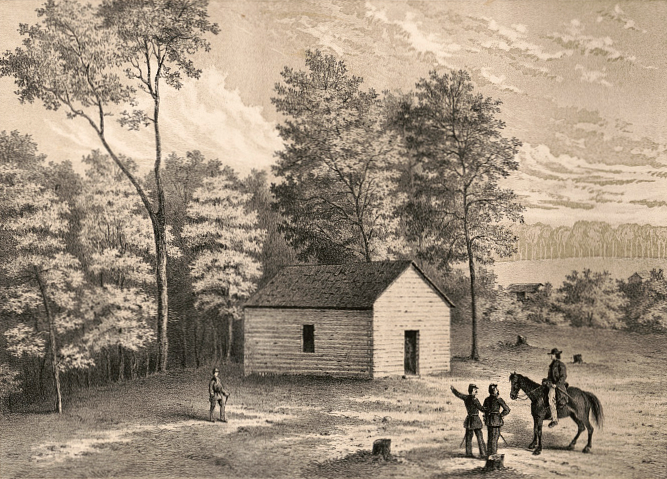
Shiloh Church image from Library of Congress Prints and Photographs Division Washington, D.C. 20540 USA. Sketched by A.E. Mathews, 31st Regt. O.V.
Library of Congress Civil War Prints & Photographs Catalog – A rich archive of historical images, including sketches like the one of Shiloh Church by A.E. Mathews. Great for readers who want to explore authentic visuals from the era.
Explore the Prints & Photographs Catalog
American Battlefield Trust – Battle of Shiloh Overview – Offers detailed maps, historical context, and preservation efforts related to the Battle of Shiloh. Perfect for readers interested in the broader military significance.
Learn more about the Battle of Shiloh
If you enjoyed reading this story, please check out this snapshot of Frank Vince’s life in 1940, capturing his family’s immigrant roots, wartime service, and the resilience of a generation.