
He didn’t write it down, but I imagine Clarance Morrison had his reasons.
Maybe it was the long hours behind a team of horses. Or the dust that hung in the air after miles of rutted roads. Or the way his muscles ached at the end of every harvest season. Whatever it was, something nudged Clarance to try something different in the summer of 1920. That’s when my great-granduncle registered what appears to be one of the first trucks in Sherman County. It was likely a Ford Model TT.
It might not look impressive by today’s standards, but at the time, it was a bold step forward.
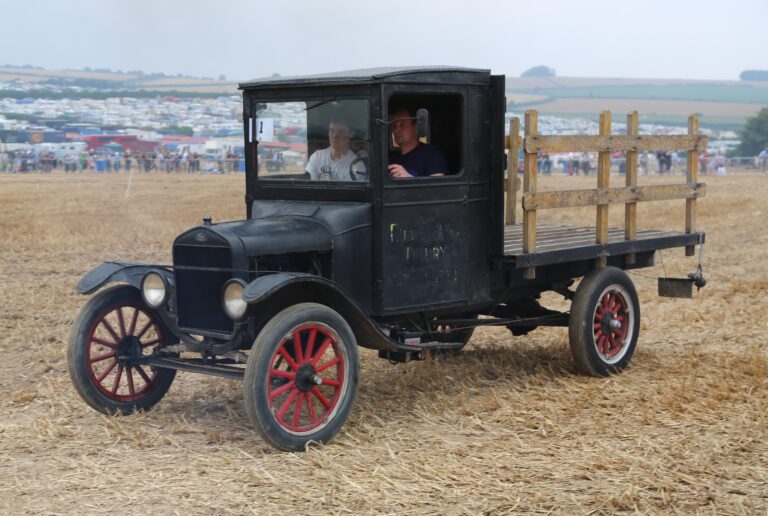
Clarance wasn’t alone in rethinking how work got done. Across the Columbia Plateau, more and more farmers were starting to swap out their wagons for machines. The land was still tough, and the days just as long, but the tools were evolving. The Ford Motor Company had released the Model TT in 1917. It was a sturdy, one-ton truck with a 20-horsepower engine and enough clearance to manage country roads without falling apart.
Clarance saw the value in that kind of machine, and he didn’t wait around. He went for it.
When the Truck Replaced the Team
Getting grain to market before the truck wasn’t just inconvenient—it could take a full day and a team of horses to move a heavy load into town and back. If the weather held. If nothing broke. And if you didn’t mind the crawl. The Model TT didn’t just cut down the time. It changed the math entirely. Suddenly, a farmer could deliver a harvest, pick up supplies, and still get home before dark. That kind of flexibility didn’t just save hours—it opened up options.
Ford sold over 50,000 of those trucks in 1920 alone. It wasn’t fancy. You still needed to know how to handle a wrench and maybe a bit of baling wire, but it worked. And in places like Sherman County—where distances were long and neighbors were few—owning a truck meant you weren’t stuck. You could move, trade, adapt.
Clarance’s decision to buy that truck wasn’t some grand gesture. It was practical. But it also marked a shift. Not just for him, but for farms like his across the country.
A Quiet Revolution, Parked by the Barn
I don’t know what happened to that old truck. There’s no photograph, no parts rusting behind the barn. But I do know this: Clarance made a choice to try something new at a time when many folks were still holding on to the old ways. That decision mattered. The Model TT became part of our family’s story because it reflects something about who we were back then and maybe who we still are.
Willing to work. Willing to take a chance.
If you’re curious what Clarance’s truck might have sounded like rattling down a dirt road in the summer heat, I found a short video of a working 1920 Ford TT. It makes more noise than speed, all gears and growl, but it was strong enough to haul a harvest and carry a little bit of hope along the way.
For some early Ford history, check out:
Ford Model TT History (Hagerty)
See the Model TT in Action
To get a better sense of what Clarance’s truck might have looked and sounded like, take a look at this short video of a working 1920 Ford TT Truck: